







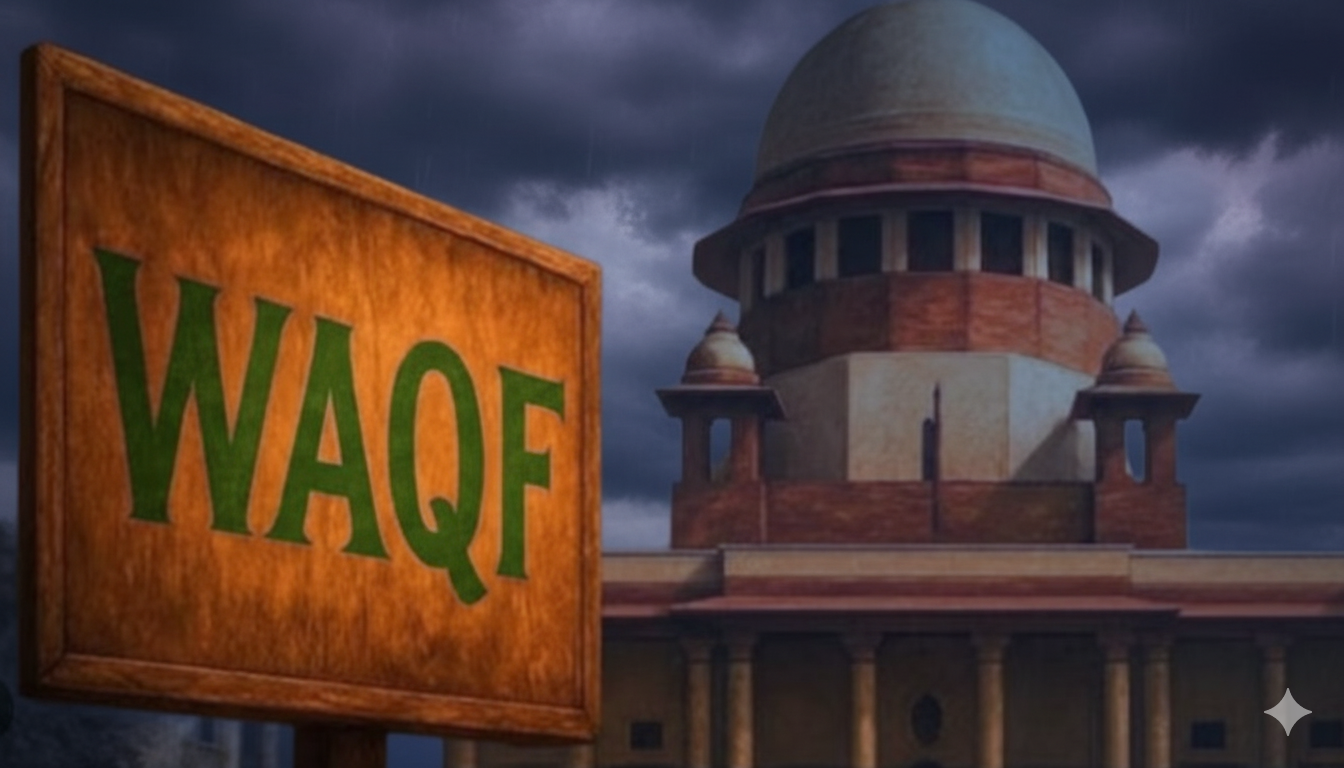
In a much-anticipated ruling that balances constitutional scrutiny with legislative deference, the Supreme Court of India on September 15, 2025, declined to impose a complete stay on the controversial Waqf (Amendment) Act, 2025, while staying specific provisions to prevent potential misuse. Pronounced by a bench comprising Chief Justice B.R. Gavai and Justice A.G. Masih, the judgment addressed pleas from over 100 petitioners, including the All India Muslim Personal Law Board (AIMPLB), Asaduddin Owaisi, and various Muslim organizations, who challenged the Act as unconstitutional being ultra vires
the Constitution of India being violative of Articles 14, 15, 19, 21, 25, 26, 29, 30 and 300A of the Constitution. and is a “creeping acquisition” of Muslim properties. The court emphasized that there is a “presumption in favor of the constitutionality of a law passed by the legislature,” but intervened where provisions appeared prima facie arbitrary, safeguarding fundamental rights under Articles 14, 25, and 26 of the Constitution.
At the outset, Shri Tushar Mehta, the learned Solicitor General, appearing on behalf of the respondent-Union of India submitted that at the hearing which took place on 16th April 2025 and 17th April 2025, this Court had identified the following three issues for consideration at the interim stage
(a) Challenge to Section 3(r) of the Amended Waqf Act, which de-recognises ‘Waqf by user’ prospectively;
(b) Challenge to special provision for Government Properties under Section 3C of the Amended Waqf Act;
(c) Changes in the composition of the Central Waqf Council and State Waqf Board under Section 9 and 14 of the Amended Waqf Act, respectively.
This position was, however, disputed by Shri Kapil Sibal, the learned Senior Counsel appearing on behalf of one of the petitioners. It was submitted by the learned Senior Counsel that there is nothing on record to that effect. We, therefore, proceeded to consider all the issues raised by the parties on the question of interim relief.
The SC finally Concludes saying the Following
(i) The following part of clause (r) of Section 3 of the Amended Waqf Act “any person showing or demonstrating that he is professing Islam for at least five years” shall stand stayed until the rules are framed by the State Government for providing a mechanism for determining the question as to whether a person has been practicing Islam for at least five years or not;
(ii) The proviso to sub-section (2) of Section 3C of the Amended Waqf Act, which reads thus: “Provided that such property shall not be treated as waqf property till the designated officer submits his report.” and the provisions of sub-sections (3) and (4) of Section 3C of the Amended Waqf Act, which read thus: “(3) In case the designated officer determines the property to be a Government property, he shall make necessary corrections in revenue records and submit a report in this regard to the State Government. (4) The State Government shall, on receipt of the report of the designated officer, direct the Board to make appropriate correction in the records.” shall stand stayed;
(iii) It is directed that unless the issue with regard to title of the waqf property in terms of Section 3C of the Amended Waqf Act is not finally decided in the proceedings initiated under Section 83 of the Amended Waqf Act by the Tribunal and subject to further orders by the High Court, neither the waqfs will be dispossessed of the property nor the entry in the revenue record and the records of the Board shall be affected. However, upon commencement of an inquiry under Section 3C of the Amended Waqf Act till the final determination by the Tribunal under Section 83 of the Amended Waqf Act, subject to further orders of the High Court in an appeal, no third-party rights would be created in respect of such properties;
(iv) It is directed that insofar as Central Waqf Council constituted under Section 9 of the Amended Waqf Act is concerned, it shall not consist of more than 4 non Muslim members out of 22. Equally, insofar as the Board constituted under Section 14 of the Amended Waqf Act is concerned, it is directed that it shall not consist of more than 3 non-Muslim members out of 11;
(v) Though, we are not inclined to stay the provision of Section 23 of the Amended Waqf Act, we direct that as far as possible, an effort should be made to appoint the Chief Executive Officer of the Board who is the exofficio Secretary from amongst the Muslim community;
(vi) We clarify that what has been observed by us hereinabove is upon our prima facie consideration for the purpose of examining as to whether an interim stay should be granted or not to the impugned Act or the provision(s) contained therein.
The observations made hereinabove will not prevent the parties from making submissions with regard to the validity of the provisions contained in the Amended Waqf Act or any of the provision(s) therein.
Reactions poured in swiftly. AIMPLB President Maulana Arshad Madani welcomed the partial stay as a “victory for constitutional rights” but vowed to pursue the full challenge. AIMIM MP Asaduddin Owaisi hailed it as a “check on majoritarian overreach,” while the Centre’s counsel, Solicitor General Tushar Mehta, defended the ruling as upholding legislative intent without blanket interference. Legal experts like former Attorney General Mukul Rohatgi praised the balanced approach, noting it aligns with precedents like the Triple Talaq case.
As the case progresses, the Supreme Court’s decision sets a precedent for judicial review of religious laws, reinforcing secularism while respecting legislative sovereignty. For India’s diverse fabric, it underscores the delicate balance between reform and rights, ensuring waqf properties—used for mosques, schools, and charities—remain protected amid modernization.











+ There are no comments
Add yours