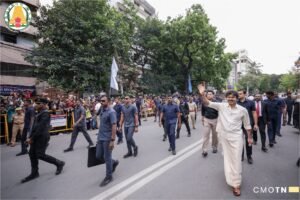
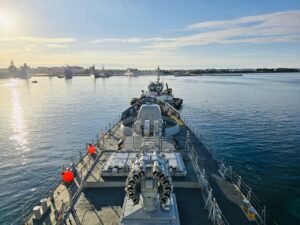


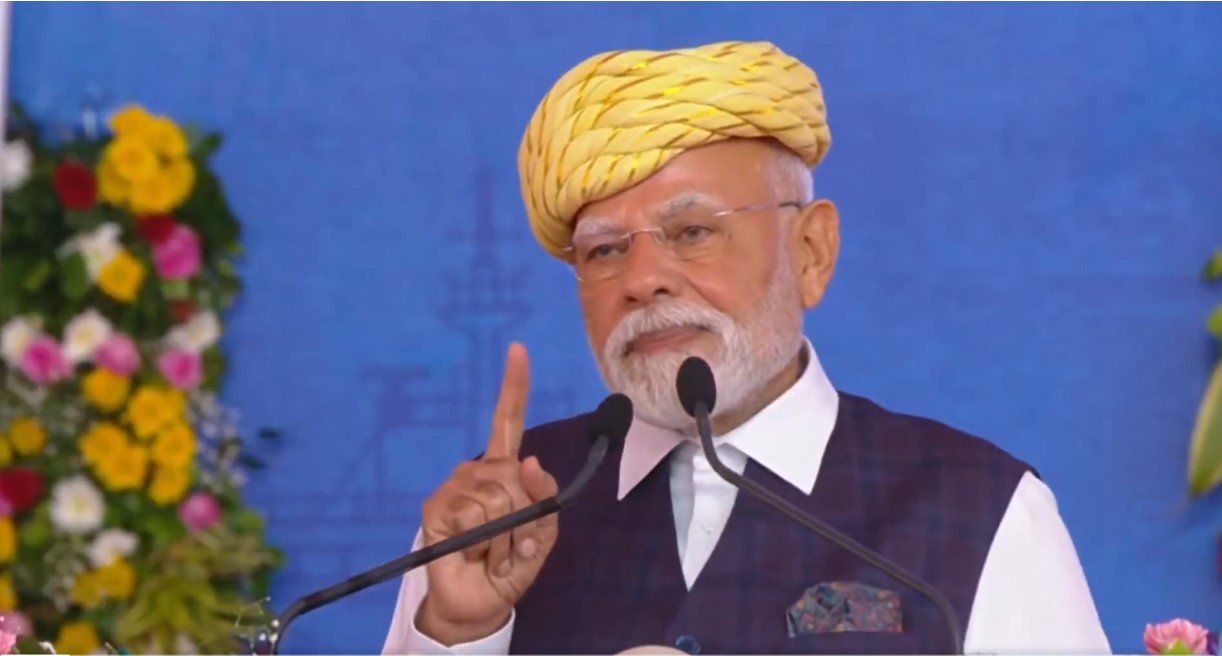
Today PM Shri Narendra Modi, has addressed the Nation during his Samudra Se Samriddhi Program in Bhavnagar, Gujrat. The Complete text of PM Speech as given by Govt of India is given Below
Popular Chief Minister of Gujarat Shri Bhupendra Bhai Patel, my colleagues in the Union Council of Ministers Sarbananda Sonowal ji, CR Patil, Mansukh Bhai Mandaviya, Shantanu Thakur, Nimuben Babhania, those who joined this program from more than 40 places of the country, all the major ports, ministers from different states, senior officials, other dignitaries and my dear brothers and sisters, greetings to all of you.
Our Bhavnagar has created a sensation, yes, the electricity just arrived. I can see a sea of people outside the pandal. I am so grateful to all of you who came in such large numbers to bless us.
Friends,
This event is taking place in Bhavnagar, but it is a program for the entire country. Today, Bhavnagar is the occasion, and Bhavnagar has been chosen as the center of this important program to reflect our path from the sea to prosperity across India. Many congratulations to the people of Gujarat and the people of Bhavnagar.
Friends,
Just now on September 17th, the good wishes that all of you have sent to our Narendra Bhai, the good wishes that I have received from the country and the world, it is not possible to thank everyone personally, but this love that I have received from every corner of India and the world, these blessings, these are my biggest asset, this is my biggest strength and hence today publicly I express my heartfelt gratitude to all the great people of the country and the world. Here a daughter has brought a picture, there a son has brought it, please collect it brother, my heartfelt blessings to these children. Thank you to those who have brought it, I am grateful to you for your love, you have worked so hard, thank you sir, thank you son, thank you friend.
Friends,
From Vishwakarma Jayanti to Gandhi Jayanti, i.e., from September 17th to October 2nd, millions of people across the country are observing the Seva Pakhwada. I’ve been told that Gujarat is also currently observing the 15-day Seva Pakhwada. However, in the past two or three days, numerous events have taken place during the Seva Pakhwada. Blood donation camps have been organized in hundreds of locations, and over one lakh people have donated blood so far. I’m sharing only the information I received about Gujarat. Cleanliness drives were organized in many cities, and lakhs of people participated in these cleanup drives. Health camps have been set up in over 30,000 locations across the state—this is a significant figure—where people are being assisted with testing and treatment, with women’s health being a key focus. I congratulate and express my gratitude to everyone involved in Seva work across the country.
Friends,
Today, at this event, I first remember Krishna Kumar Singh ji. Joining Sardar Saheb’s mission, he made a significant contribution to India’s unity. Today, inspired by such great patriots, we are strengthening India’s unity and reinforcing the spirit of “One India, Best India.”
Friends,
Today, I have come to Bhavnagar just as the sacred festival of Navratri is about to begin. This time, due to the reduction in GST, the markets will be even more vibrant, and in this festive atmosphere, we are celebrating the grand festival of prosperity from the sea. Brothers of Bhavnagar, please forgive me for speaking in Hindi because people from across the country are participating. When millions of people from across the country are involved in the program, I apologize and have to speak in Hindi.
Friends,
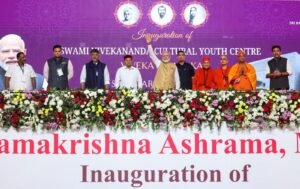
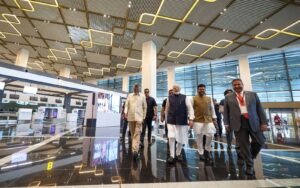
21st-century India is seeing the sea as a huge opportunity. A short while ago, the foundation stone was laid and projects worth thousands of crores of rupees were inaugurated to accelerate port-led development. The International Cruise Terminal in Mumbai was also inaugurated today to promote cruise tourism in the country. Several projects related to the development of Bhavnagar and Gujarat have also been launched. I extend my best wishes to all my countrymen and the people of Gujarat.
Friends,
Today, India is moving forward with a spirit of global brotherhood. We have no major enemy in the world. If we truly have an enemy, it is our dependence on other countries. This is our biggest enemy. And together, we must defeat this enemy of India, the enemy of dependence. We must always reiterate: the greater the foreign dependence, the greater the country’s failure. For global peace, stability, and prosperity, the world’s most populous nation must become self-reliant. If we remain dependent on others, our self-respect will be damaged. We cannot leave the future of 1.4 billion countrymen to others. We cannot leave the resolve for the country’s development to the dependence of others. We cannot put the future of future generations at stake.
And so, brothers and sisters,
We have a saying in Gujarati, “There’s only one cure for a hundred problems.” There’s only one cure for a hundred problems, and that’s a self-reliant India. But to achieve this, we’ll have to face challenges and continually reduce our dependence on other countries. And now, India must become self-reliant and stand strong before the world.
Brothers and sisters,
India has no shortage of potential. But after independence, the Congress party ignored every one of India’s strengths. Therefore, even after six to seven decades of independence, India hasn’t achieved the success it deserved. There were two major reasons for this: For a long time, the Congress government kept the country entangled in the license-quota raj, isolating it from the world market. And then, when the era of globalization arrived, the only path to imports was taken. And even within that, scams worth thousands and lakhs of crores were committed. These policies of the Congress governments caused great harm to the country’s youth. These policies prevented India’s true strength from being revealed.
Friends,
Our shipping sector is a prime example of the country’s losses. You know that India was a major maritime power for centuries, and we used to be the world’s largest shipbuilding center. Ships built in India’s coastal states fueled national and global trade. Even 50 years ago, we used ships built in India. At that time, more than 40 percent of India’s imports and exports were handled by domestically built ships. But then, the country’s shipping sector also fell victim to the Congress party’s cunning tactics. Instead of focusing on shipbuilding in India, Congress preferred to pay charters to foreign ships. This crippled India’s shipbuilding ecosystem, and dependence on foreign ships became a compulsion. The result was that 50 years ago, where 40 percent of trade was conducted on Indian ships, that share dropped to just five percent. This means we became dependent on foreign ships for 95 percent of our trade. We suffered huge losses due to this dependence on foreign ships.
Friends,
Today, I want to present some statistics to the nation. Your countrymen will be astonished to learn that India annually pays approximately $75 billion, or approximately six lakh crore rupees, to foreign shipping companies for shipping services. This amount is almost as much as India’s defense budget. Imagine how much money we’ve given to other countries in freight alone over seven decades. Our money has created millions of jobs abroad. Imagine if previous governments had invested even a small portion of this money in their shipping industry, the world would be using our ships today, we would be receiving millions of crores of rupees in shipping services, and we would have saved that much.
Friends,
If India is to develop by 2047, the 100th anniversary of its independence, it must become self-reliant. India has no choice but to be self-reliant. 1.4 billion citizens must have a single resolve: whether it’s chips or ships, we must make them in India. With this vision, India’s maritime sector is embarking on next-generation reforms. Starting today, every major port in the country will be freed from various documents and various processes. The One Nation, One Document and One Nation, One Port process will further simplify trade and business. Recently, as our Minister Sarbananda Sonowal mentioned, during the monsoon session of Parliament, we amended several outdated laws that had been in place since the British era. We have initiated a series of reforms in the maritime sector. Our government has presented five maritime laws to the nation in a new avatar. These laws and the introduction of these laws will bring about a huge change in the shipping sector and port governance.
Friends,
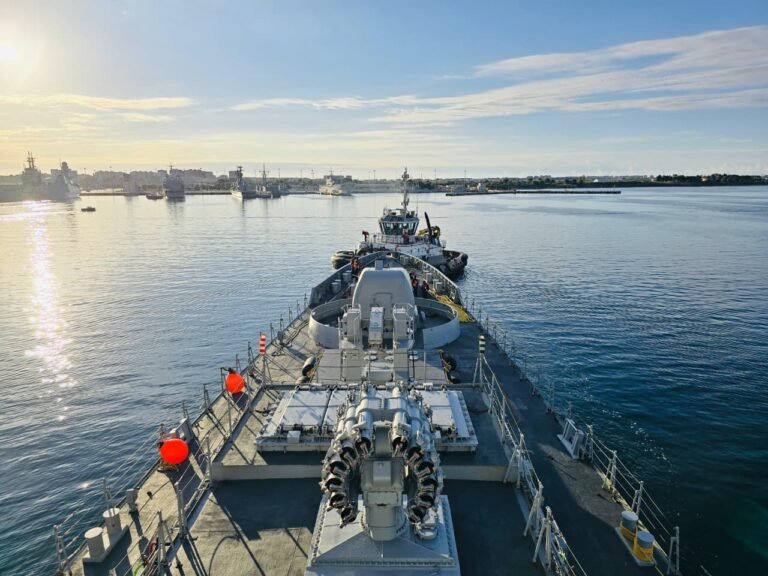
India has been an expert in building large ships for centuries. Next-generation reforms will help restore this forgotten glory. In the past decade, we have inducted more than 40 ships and submarines into the Navy. With the exception of one or two, all of these were built in India. You may have heard of INS Vikrant, the massive INS Vikrant, also built in India. The high-quality steel used to build it was also manufactured in India. This means we have the capability, we have no shortage of skills. Today, I assure my countrymen of the political will needed to build large ships.
Friends,
Yesterday, a historic decision was made to strengthen the country’s maritime sector. We have made a major change in national policy. The government has now recognized large ships as infrastructure. When a sector is recognized as infrastructure, it benefits significantly. Now, large shipbuilding companies will find it easier to obtain loans from banks, they will also receive interest rate discounts, and all the other benefits of infrastructure financing will also be available to these shipbuilding companies. This government decision will ease the burden on Indian shipping companies and help them advance in global competition.
Friends,
To make India a major maritime power in the world, the Indian government is working on three more major schemes. These three schemes will facilitate financial support for the shipbuilding sector, help our shipyards adopt modern technology, and significantly improve design and quality. More than seventy thousand crore rupees will be spent on these schemes in the coming years.
Friends,
I remember that in 2007, when I was serving you as Chief Minister, Gujarat hosted a major seminar on shipbuilding opportunities. During that time, we supported the shipbuilding ecosystem in Gujarat. Now, we are taking extensive steps to promote shipbuilding across the country. The experts here know that shipbuilding is no ordinary industry. The shipbuilding industry is known worldwide as the Mother of All Industries, the mother of all industries. Because it involves more than just building a ship, the industries associated with it expand. Steel, machinery, electronics, textiles, paints, IT systems—many such industries—are supported by the shipping industry. This benefits small and micro-scale industries, MSMEs. Research shows that every rupee invested in shipbuilding nearly doubles the investment in the economy. And every job created at a shipyard creates six to seven new jobs across the supply chain. Meaning, if 100 jobs are created in the shipbuilding industry, more than 600 jobs are created in related sectors. Such is the massive multiplier effect of shipbuilding.
Friends,
We are also focusing on the skill sets required for shipbuilding. Our ITIs will be useful in this regard, and the role of maritime universities will expand. Over the past years, we have established new systems in coastal areas through coordination between the Navy and the NCC. These NCC cadets will be prepared for roles in both the Navy and the commercial sector.
Friends,
Today’s India is moving forward with a different mindset. We now demonstrate that we are achieving our goals ahead of schedule. In the solar sector, India is achieving its targets four to five years ahead of schedule. India is also achieving tremendous success in the goals we set 11 years ago for port-led development. We are building large ports across the country for large ships and enhancing port connectivity through schemes like Sagarmala.
Friends,
India has doubled its port capacity in the last 11 years. Before 2014, the average ship turnaround time in India was two days. Today, the ship turnaround time in India has reduced to less than one day. We are also building new and larger ports in the country. Recently, the country’s first deep-water container transshipment port was inaugurated in Kerala. Vadhavan Port is being built in Maharashtra at a cost of more than Rs 75,000 crore. It will be one of the top ten ports in the world.
Friends,
Today, India’s share in seaborne trade is only 10%. We need to increase this further. We want to nearly triple our share of global maritime trade by 2047. And we will do it.
Friends,
As our maritime trade grows, so too is the number of our seafarers. These are hardworking professionals who operate ships at sea, manage engines and machinery, and oversee loading and unloading. A decade ago, we had fewer than 125,000 seafarers. But today, their number has surpassed 300,000. Today, India is among the top three countries in the world, providing the largest number of seafarers, and this increases employment opportunities for India’s youth. This means that India’s growing shipping industry is also increasing its global strength.
Friends,
India has a rich maritime heritage. Our fishermen and our ancient port cities are symbols of this heritage. Our Bhavnagar, Saurashtra, is a prime example of this. We must pass this heritage on to future generations and showcase our strengths to the world. That’s why we’re building a magnificent maritime museum in Lothal. It will become the world’s largest maritime museum. Like the Statue of Unity, it will become India’s new identity. I’m going there later today.
Friends,
India’s coastline will become the gateway to India’s prosperity. And I can see with great pride, and I can foresee that India’s coastline is going to become the gateway to India’s prosperity. I am happy that this coastline of Gujarat is once again becoming a boon for the region. Today, this entire region is showing the country a new path of port-led development. Today, Gujarat’s ports handle forty percent of the cargo that comes into the country by sea. Now these ports will also benefit from the Dedicated Freight Corridor. This will make it easier to transport goods to other parts of the country faster. This will also increase the efficiency of the ports further.
Friends,
A large shipbreaking ecosystem is also developing here. The Alang shipbreaking yard is a prime example of this, providing employment to a large number of young people.
Friends,
For a developed India, we must work rapidly in every field, in every sector. And we all know that the path to a developed India lies through a self-reliant India. Therefore, we must remember that whatever we buy should be indigenous. Whatever we sell should be indigenous. I would like to urge all our shopkeepers to put up a poster in their shops that reads, “Say with pride, this is indigenous.” This effort will transform every celebration into a festival of India’s prosperity. With this spirit, I once again wish you all a Happy Navratri! A little boy has brought a picture. He’s been standing there for so long, his hands must be hurting. Someone please collect it. He’s a little boy. Well done, son. Well done, son, I’ve found your picture. There’s no need to cry, son. I’ve found it, I’ve found your picture. If your address is written on it, I’ll definitely write to you.
Friends,
What greater asset in life can there be than the love of these little children? I once again express my gratitude to you for the grand welcome and honour extended to me today. And I know that when Operation Sindoor took place, the entire Bhavnagar was present in the field. I know your temperament, and I express my heartfelt gratitude to you for this too. Brothers and sisters of Bhavnagar, please put some emphasis on the Mandavi (Mandap) of Navratri, so that the message of self-reliant India reaches all the people of the country through your Mandavi (Mandap). Thank you very much, brothers!






+ There are no comments
Add yours