






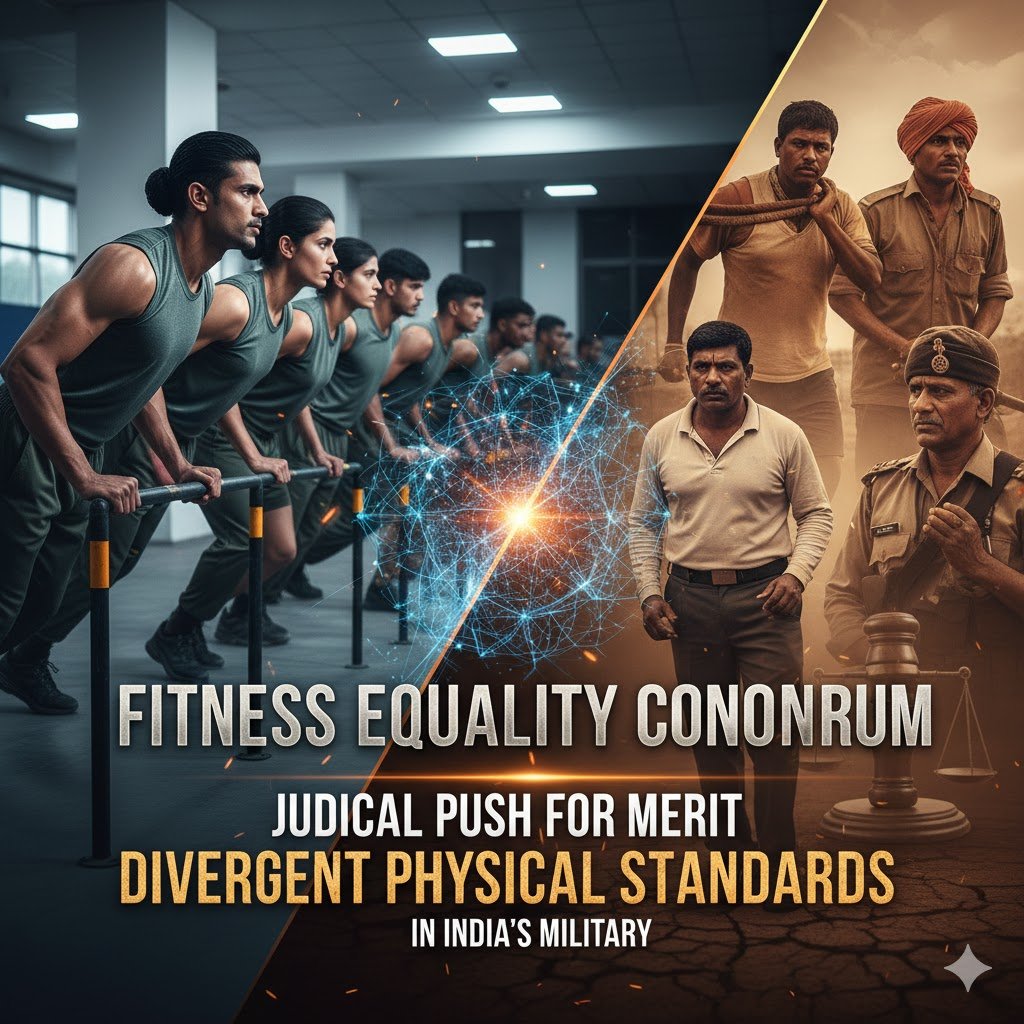
India’s pursuit of gender equality in the armed forces, driven by Supreme Court mandates for unified merit lists in recruitment, exposes a troubling paradox. Women are granted significantly eased physical fitness benchmarks—such as up to Three additional minutes for a 3.2 km run compared to men—sparking concerns over combat readiness in life-or-death war scenarios. The judiciary’s emphasis on “equality” in selection sidesteps the reality that equal female representation, under these relaxed norms, could undermine warfighting efficiency by affecting unit fitness, load-carrying ability, and operational pace. With women now comprising nearly 12% of officers, a push toward 50% parity without standardized physical criteria raises a critical question: Will India’s military retain its battle-ready edge or become a showcase for symbolic equality?
“In warfare, physical fitness is non-negotiable—it’s the line between triumph and defeat. Lowering standards for half the force jeopardizes the entire unit,” cautions retired Lt. Gen. Prakash Katoch, reflecting a growing chorus of critics who argue judicial idealism overlooks battlefield realities.
Relaxed Standards: Equal Opportunity, Unequal Performance
The Proposed Combined Physical Tests (CPT) table for the Indian Army, which is shared on Social Networking Platforms citing likely full rollout on April 1, 2026—lays bare the enduring paradox of gender “equality” in military fitness. Women are Given upto 3 Minutes Relaxation in a 2 Mile Run, making a women under 35 to have Fitness standards equivalent to Men over 45 Year. The Standards are almost 10 Years in differential. Example we take Push Ups as a mandatory Fitness test, a 25 Yrs Old Women is expected to Do 14 Pushups which is the Standard expected from a Male Soldier who is 10 yrs Older. So By increasing the Number of Women Officer/ Soldiers in the Army are we trying to increase the Physical Fitness age by about 10 Years?
Judicial Mandate: “Merit” Without Physical Alignment
The Supreme Court’s 2025 ruling in Arshnoor Kaur v. Union of India highlights this disconnect. Petitioners Arshnoor Kaur (447 marks) and Astha Tyagi (477 marks) led the women’s JAG list but faced rejection due to a 6:3 male quota. The Court overturned it, directing:
- Unified Merit List: Gender-neutral selection.
- Minimum 33% Women: A baseline, not a limit—prioritizing top candidates.
- No Induction Caps: No arbitrary restrictions on female entry.
“Equality demands merit, not quotas. Physiological arguments cannot excuse discrimination,” declared Justices Nagarathna and Kaul.
This builds on Babita Puniya (2020), enabling Permanent Commissions and command roles for women. While effective for non-combat JAG roles with minimal physical demands, the ruling overlooks combat arms, where relaxed physical standards allow less-fit women to join alongside fitter men. Critics dub this “partial equality”—equal access, unequal preparedness.
Bridging the Gap: Uniform Standards or Strategic Roles?
The judiciary enforces entry equality, but the Army must address fitness alignment. Options include:
- Uniform Thresholds: Elevating women’s standards to men’s, risking <10% female induction.
- Hybrid Scoring: Balancing merit and fitness (60:40 ratio).
- Role Division: Women in tech/support roles; men in frontline combat.
Without adjustment, parity could weaken the force. With China’s border pressures mounting, India cannot afford an equality myth over a battle-ready reality. The Court may need to mandate fitness parity to align ideals with operational needs.








+ There are no comments
Add yours