







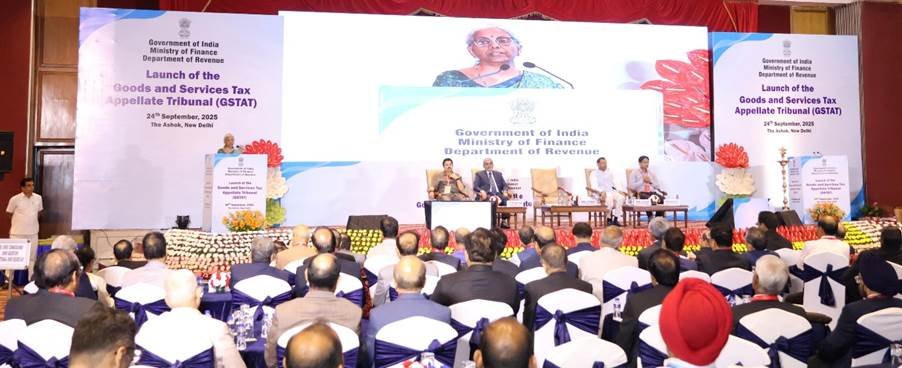
New Delhi, September 24, 2025 – Union Finance and Corporate Affairs Minister Smt. Nirmala Sitharaman officially inaugurated the Goods and Services Tax Appellate Tribunal (GSTAT) in New Delhi today, marking a significant advancement in India’s indirect tax framework. The event was attended by Union Minister of State for Finance Shri Pankaj Chaudhary, GSTAT President Justice Shri Sanjaya Kumar Mishra, Haryana Minister Shri Rao Narbir Singh, senior officials from the Department of Revenue, representatives from state and central GST units, prominent legal professionals, and industry stakeholders.
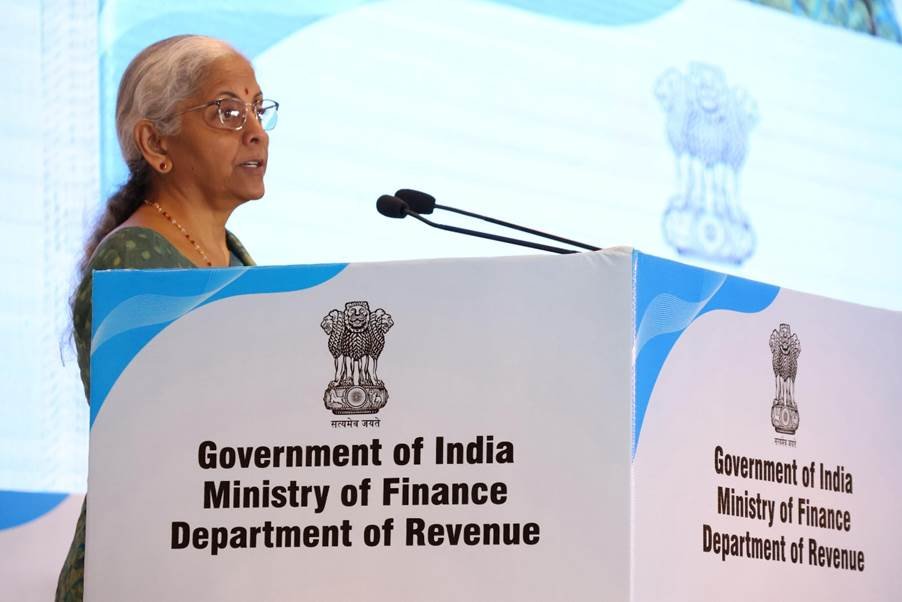
In her remarks, Smt. Sitharaman described the GSTAT launch as more than an institutional milestone—it reflects the remarkable progress of GST over the past eight years and signals an unwavering commitment to ongoing improvement and adaptation. She emphasized that GST was founded on the principle of unity—unifying policy, compliance, and economic goals. Since its inception, the GST Council, in collaboration with states and union territories, has enhanced the system’s robustness, establishing it as a steady revenue stream, broadening the tax base, promoting formalization, and anchoring India’s economic growth narrative.
The Minister stressed that reform is an ongoing journey, with GST evolving around the ideals of simplicity and enhanced quality of life. She referenced Prime Minister Shri Narendra Modi’s recent announcement from the Red Fort about the Next Generation GST Reforms, guided by the philosophy of ‘Nagarik Devo Bhava’ (the citizen is divine). This citizen-centric approach prioritizes time, clarity, and savings, culminating in a nationwide GST Bachat Utsav this festive season across various sectors and daily life.
Smt. Sitharaman outlined key priorities for GSTAT, advocating for clear, jargon-free rulings, simplified processes with checklists, predominantly digital filings, virtual hearings, and defined timelines for case listing, adjudication, and judgment delivery. The goal, she noted, is to minimize legal hurdles, streamline complexity, address litigation delays proactively, accelerate cash flow, boost confidence among MSMEs and exporters, and ensure tangible benefits for citizens. She added that ease of living for taxpayers extends beyond filings and refunds to include efficient, equitable dispute resolution.
The Finance Minister explained that GSTAT builds on the reform trajectory, serving as a critical step toward improving the business environment and providing a vital platform for justice. She noted that the first appeal in tax disputes lies within the tax administration, while the second appeal—whether originating from central or state authorities—will now be centralized at this independent GSTAT, evolving the 2017 vision of ‘One Nation, One Tax, One Market’ into ‘One Nation, One Forum for Fairness and Certainty.’
Shri Pankaj Chaudhary, Union Minister of State for Finance, hailed the launch as a deepening of reforms championed by Prime Minister Modi, aimed at fostering transparent governance, empowering citizens, and supporting businesses. He highlighted years of efforts to simplify, fair, and digitize the system, inspired by the ‘Minimum Government, Maximum Governance’ mantra. Innovations like digital return filings, e-invoicing, and online refunds have eased taxpayer burdens and strengthened public trust. The GSTAT, he said, will offer a uniform, transparent, and accessible dispute resolution platform, reducing uncertainty, ensuring nationwide consistency, and delivering timely justice to all taxpayers—big and small. This, he added, translates to simpler taxation and fair pricing for citizens, less paperwork for small businesses, growth opportunities for startups, and a robust economic impact, reinforcing India’s global economic standing.
Shri Chaudhary emphasized that a robust appellate system builds trust in swift, fair justice, assuring businesses of minimal litigation and investors of a reliable market. He credited the GST Council’s cooperative federalism for balancing national and state interests, wishing all stakeholders success in sustaining this collaborative spirit.
Justice Sanjaya Kumar Mishra highlighted GSTAT’s role in tackling the backlog of GST appeals and establishing legal precedents, crediting the joint efforts of central and state governments for its timely setup and expressing optimism for continued support.
Shri Arvind Shrivastava, Revenue Secretary, noted that GSTAT arrives at a crucial point in GST’s development, offering a dedicated national platform to ensure equitable representation and fair resolution of disputes. He outlined its design around three pillars—structure, scale, and synergy: a blend of judicial and technical expertise, extensive reach with state benches and single-member options for minor cases, and a fusion of technology and human skill for efficient justice delivery.
Shri Shrivastava announced that the Department of Revenue, alongside GSTN and NIC, has launched a digital GSTAT e-Courts Portal to streamline operations from the outset. Featuring e-filing, case management tools, and virtual court modules, the portal enhances transparency and efficiency, setting a new standard for tribunals in India. To ease the transition, GSTAT has permitted staggered appeal filings until June 30, 2026, supported by comprehensive guides, FAQs, notes, and videos on the portal to assist taxpayers, including MSMEs, in navigating the process.
The GSTAT launch is a pivotal moment in refining India’s indirect tax system, offering taxpayers a specialized avenue for justice and enhancing the regime’s orderliness, predictability, and credibility. As a cornerstone institution, it ensures the tax administration remains responsive, transparent, and aligned with ease-of-doing-business principles.
About GSTAT
The Goods and Services Tax Appellate Tribunal (GSTAT), established under GST legislation, serves as an independent body to adjudicate appeals against GST Appellate Authority rulings. It operates through a Principal Bench in New Delhi and 31 State Benches across 45 locations, ensuring broad accessibility. Each bench includes two Judicial Members, one Technical Member (Centre), and one Technical Member (State), blending judicial insight with technical expertise from both levels of governance, reflecting cooperative federalism for impartial and uniform decisions.










+ There are no comments
Add yours