







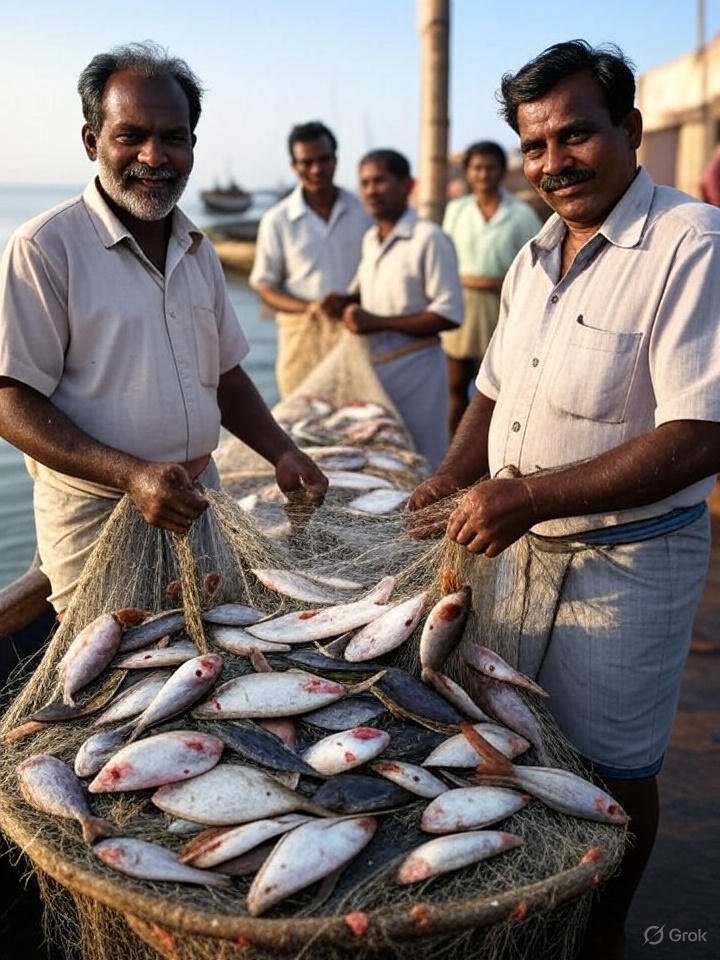
In a significant development for India’s burgeoning seafood industry, the European Union (EU) has rolled out new trade agreements aimed at enhancing imports of Indian fish products. Announced on September 10, 2025, during a high-level virtual summit between Indian Commerce Minister Piyush Goyal and EU Trade Commissioner Valdis Dombrovskis, these pacts mark a pivotal step in strengthening bilateral economic ties. The agreements focus on reducing tariffs on select seafood items, and promoting sustainable fishing practices, potentially increasing India’s fish exports to the EU by up to 25% in the coming years. This move comes at a time when India is aggressively pushing its “Blue Economy” agenda, leveraging its vast coastline and marine resources to drive economic growth.
Key Highlights:
- In 2025, 102 new establishments added to the EU-approved list for fishery exports.
- Reflects India’s commitment to food safety, traceability, and compliance with EU regulations.
- Strengthens India’s position as a trusted supplier of high-quality seafood.
- Expected to boost export volumes, generate employment, and enhance foreign exchange earnings
India’s seafood sector has been a silent powerhouse in the country’s export basket. Valued at over $7 billion in 2024, according to data from the Marine Products Export Development Authority (MPEDA), it employs millions in coastal states like Andhra Pradesh, Kerala, Tamil Nadu, and West Bengal. The EU, being one of the largest markets for seafood globally, imported around €200 million worth of Indian fish products last year, primarily shrimp, squid, and cuttlefish. However, stringent EU regulations on food safety, traceability, and environmental sustainability have often posed barriers, leading to rejections and market access issues. The new agreements address these pain points by harmonizing standards and introducing mutual recognition of certification processes.
Under the revamped framework, the EU has agreed to lower tariffs on processed seafood from 12-15% to as low as 5-7% for key items like frozen shrimp and canned tuna. This tariff reduction is expected to make Indian products more competitive against rivals from Vietnam and Ecuador. Additionally, the pacts include provisions for capacity building, where EU experts will train Indian exporters on compliance with the EU’s Farm to Fork strategy, which emphasizes eco-friendly practices. India, in turn, has committed to enhancing its traceability systems using blockchain technology to ensure that exported fish are sourced sustainably, free from illegal, unreported, and unregulated (IUU) fishing.
This collaboration is not just about trade; it’s a strategic alignment amid global supply chain disruptions. The Russia-Ukraine conflict and Red Sea tensions have inflated shipping costs and delayed deliveries, prompting the EU to diversify its seafood sources. India, with its robust aquaculture sector, emerges as a reliable partner. For instance, Andhra Pradesh alone produces over 3 million tonnes of shrimp annually, much of which is exported. The agreements could add $500 million to India’s export revenue in the next fiscal year, according to estimates from the Federation of Indian Export Organisations (FIEO).
The relevance to India’s economy cannot be overstated. The seafood industry supports over 14 million livelihoods, many in rural and coastal areas where alternative employment is scarce. Women play a crucial role in processing and packaging, making this sector a key driver of gender-inclusive growth. With the government’s focus on doubling farmers’ income, initiatives like the Pradhan Mantri Matsya Sampada Yojana (PMMSY) have already invested ₹20,000 crore in modernizing fisheries. The EU pacts complement this by opening premium markets, where Indian organic and antibiotic-free shrimp fetch higher prices.
However, challenges remain. Environmental concerns are paramount; overfishing and habitat destruction in Indian waters have drawn criticism from international watchdogs like the World Wildlife Fund (WWF). The agreements mandate adherence to the EU’s strict rules on maximum residue limits (MRLs) for antibiotics and heavy metals, requiring Indian exporters to upgrade their facilities. Small-scale fishermen, who form the backbone of the industry, may struggle with compliance costs. To mitigate this, the Indian government has announced subsidies and training programs, partnering with EU-funded projects.
From a diplomatic angle, these trade deals reinforce India-EU relations, which have deepened since the resumption of Free Trade Agreement (FTA) negotiations in 2022. The EU is India’s second-largest trading partner, with bilateral trade exceeding €100 billion. Seafood agreements could pave the way for broader FTA breakthroughs, covering services, investments, and intellectual property. Amid India’s push for self-reliance, such partnerships balance import substitution with export promotion, aligning with the “Viksit Bharat” vision.
Looking ahead, the agreements include a review mechanism every two years to address emerging issues like climate change impacts on marine ecosystems. Rising sea temperatures and acidification threaten fish stocks, necessitating joint research initiatives. India and the EU plan to collaborate on marine biodiversity projects, potentially accessing EU’s Horizon Europe funding for sustainable aquaculture technologies.
In conclusion, the EU’s boost to Indian fish exports is a win-win, fostering economic growth, job creation, and sustainable development. As India aims to become a $5 trillion economy, sectors like fisheries will play a vital role. This partnership not only opens doors to lucrative markets but also encourages responsible practices, ensuring the blue economy thrives for generations. With careful implementation, India can position itself as a global leader in seafood exports, turning its coastal riches into national prosperity.










+ There are no comments
Add yours