







Researchers at the Raman Research Institute (RRI), an autonomous institution backed by India’s Department of Science and Technology (DST), have developed a groundbreaking dual-trap optical tweezers system, making advanced biomolecular research more accessible to Indian scientists. This innovation could spark breakthroughs in neuroscience, drug discovery, and medical research by enabling precise force measurements on single molecules.
Optical tweezers, a Nobel Prize-winning technology from 2018, use focused laser beams to manipulate microscopic objects with unparalleled precision. Widely applied in biology, bioengineering, materials science, and nanotechnology, they measure minute forces in applications like studying biomolecular interactions, biopolymer mechanics, and protein nanomachines. However, traditional dual-trap systems, which use two laser beams to control particles, face limitations due to signal interference when detecting light transmitted through trapped objects.
A Novel Approach to Dual-Trap Systems
RRI’s new design overcomes these challenges with a confocal detection system that uses backward-scattered light to track particle positions. Each trap’s detector captures only the light reflected from its respective trap, eliminating interference or “cross-talk” between the two signals. This ensures independent, accurate measurements, even when traps are moved or positioned close together.
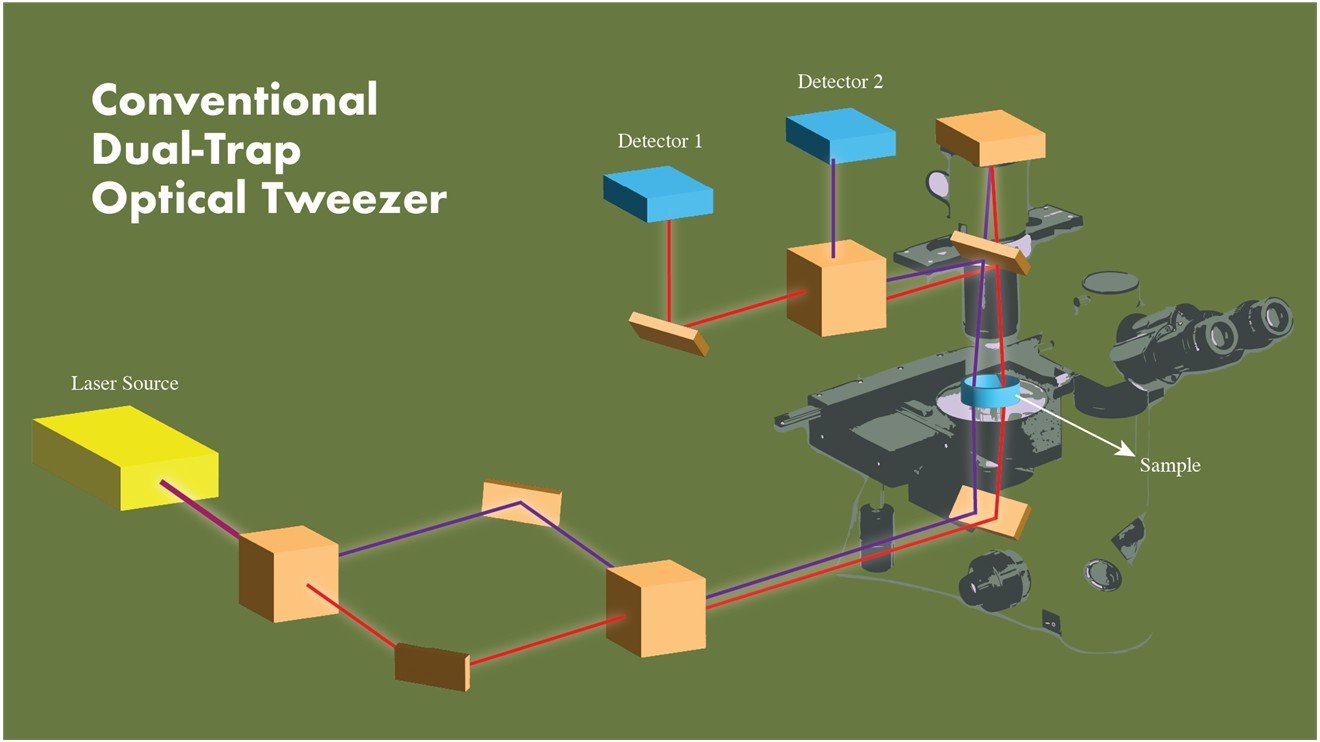
Figure 1: Traditional Dual-Trap Optical Tweezers Setup
Conventional systems rely on transmitted light, leading to signal interference, complex optics, and alignment issues during trap movement.
Figure 2: RRI’s Dual-Trap Optical Tweezers Setup
The innovative design uses backward-scattered light, ensuring stable, interference-free detection and seamless integration with standard microscopes.
“This novel system leverages laser light reflected by the sample to monitor trapped particle positions, bypassing the limitations of traditional dual-trap setups. Its single-module design integrates effortlessly with existing microscopy platforms, enhancing versatility,” said Md Arsalan Ashraf, a PhD scholar at RRI.
Overcoming Traditional Limitations
Traditional dual-trap systems struggle with three key issues:
- Signal Interference: Light from one trap can interfere with the other, reducing measurement accuracy. Efforts to mitigate this often involve costly separate lasers or intricate optics.
- Incompatibility with Imaging: These systems can disrupt other microscopy functions, like fluorescence or phase-contrast imaging, limiting their versatility.
- Alignment Challenges: Moving traps requires realigning detectors, causing downtime and compromising precision in dynamic experiments.
RRI’s design addresses these flaws elegantly. By using backward-scattered light, it eliminates cross-talk, allowing traps to operate independently even at close proximity. The system remains stable under temperature fluctuations and supports trap movement without requiring detector adjustments. Its compact, modular structure integrates seamlessly with standard microscopes, preserving their imaging capabilities without modifications.
“This single-module design simplifies high-precision force measurements for single molecules, soft material studies, and micromanipulation of biological samples like cells, making it both cost-effective and user-friendly,” said Pramod A Pullarkat, lead principal investigator at RRI.
Impact and Commercial Potential
This breakthrough enhances the precision and reliability of dual-trap optical tweezers, offering a robust solution for advanced research. Its compatibility with existing microscopes and ability to maintain accuracy during dynamic experiments make it a game-changer for studying biomolecular forces, cellular mechanics, and material properties.
From an intellectual property standpoint, the design’s innovative approach to eliminating signal interference and its minimalist integration make it a strong candidate for patent protection. The RRI team aims to commercialize this technology as a plug-and-play add-on module for commercial microscopes, democratizing access to cutting-edge tools for scientists across India and beyond.
This advancement not only empowers researchers to probe the mechanics of life at the molecular level but also positions India as a hub for innovative scientific instrumentation, potentially driving discoveries in neuroscience, drug development, and beyond.

















+ There are no comments
Add yours