



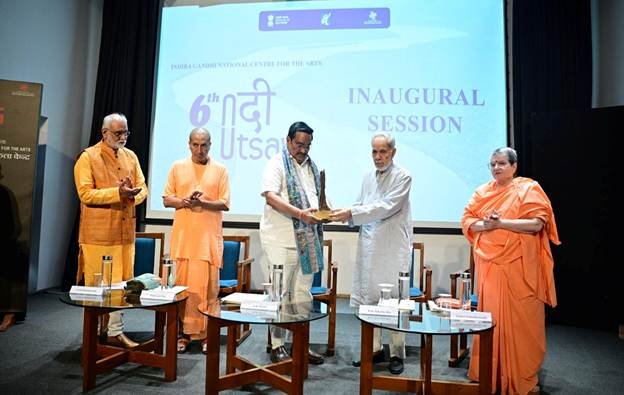
New Delhi, September 26, 2025 – The 6th edition of Nadi Utsav, hosted by the Indira Gandhi National Centre for the Arts (IGNCA) under the Ministry of Culture, Government of India, was launched today at IGNCA, Janpath, by Shri C.R. Patil, Minister of Jal Shakti. The event welcomed spiritual leader Shri Gaurang Das of ISKCON, Sadhvi Vishudhanand Bharti Thakur, Shri Rambahadur Rai, IGNCA President, and Dr. Sachchidanand Joshi, Member Secretary of IGNCA, among other dignitaries.
The festival, which celebrates rivers as essential ecological arteries and cultural treasures, drew an enthusiastic crowd of academics, artists, practitioners, and students. In his opening remarks, Shri C.R. Patil underscored the critical role rivers play in sustaining communities and defining India’s cultural identity. He stressed the urgent need for collective action to protect these water bodies for future generations, saying, “India thrives with rivers, home to the majestic Ganga. It’s our responsibility to keep them free from pollution.” He outlined ongoing conservation efforts at short-term, mid-term, and long-term levels, crediting Prime Minister Shri Narendra Modi’s leadership through initiatives like Water Vision@2047.
Highlighting their cultural depth, Patil described rivers as more than resources—they are the lifeblood of our emotions and heritage. He warned of the significant harm caused by human activity and praised IGNCA for sustaining Nadi Utsav as a platform for awareness.
Shri Gaurang Das likened rivers to symbols of resilience and vitality, citing the Ganga’s journey from Gangotri to the Bay of Bengal as a lesson in perseverance. He expressed concern over the Yamuna’s current state, urging shared responsibility for its restoration, and lauded IGNCA’s efforts.
Sadhvi Vishudhanand Bharti Thakur shared insights from her travels across India, from the Northeast to Kanyakumari, advocating for a deeper dialogue with rivers to appreciate their ecological and spiritual wealth. She called for serious study of their biodiversity.
Shri Rambahadur Rai reflected on rivers as embodiments of culture, faith, and duty, recalling a 1980s Yamuna trip with Anupam Mishra that revealed 26 drains polluting the river. He expressed hope in current cleaning projects and embankments, invoking figures like Pandit Madan Mohan Malaviya and Sunderlal Bahuguna to inspire vigilance. He suggested Nadi Utsav become a perpetual call to action.
Dr. Sachchidanand Joshi welcomed attendees, noting that urban lifestyles have eroded our connection with rivers. He explained that rapid development and exploitation have shifted this bond into a consumerist dynamic, and Nadi Utsav aims to rekindle reverence and devotion.
The first day featured the launch of the National Seminar on “Riverscape Dynamics: Changes and Continuity,” uniting experts to explore rivers’ cultural, ecological, and artistic roles. Over 300 research papers were submitted, with 45 selected for presentation, in partnership with Delhi University’s English Department.
Parallel to this, the “My River Story” Documentary Film Festival debuted with screenings like “Gotakhors: Disappearing Diving Communities,” “River Man of India,” “Arth Ganga,” “Yamuna’s Sewage Treatment Plant,” and “Cauvery – River of Life,” addressing ecological issues, traditions, and human-river ties.
Nadi Utsav bridges tradition and modernity, keeping communities linked to their river heritage. The day ended with engaging discussions and classical performances by Guru Sudha Raghuraman and her ensemble, following a vote of thanks by Prof. K. Anil Kumar, Head of Janapada Sampada. The festival runs until September 27, 2025, with cultural events, exhibits, and dialogues reinforcing the bond between rivers, nature, and culture.






+ There are no comments
Add yours