




In a momentous boost to India’s aviation infrastructure, Prime Minister Narendra Modi inaugurated Phase 1 of the Navi Mumbai International Airport (NMIA) on October 8, 2025, marking the dawn of a new era for air travel in the bustling Mumbai Metropolitan Region (MMR). The ceremony, attended by Maharashtra Chief Minister Devendra Fadnavis, Deputy Chief Ministers Eknath Shinde and Ajit Pawar, and Union Civil Aviation Minister Kinjarapu Ram Mohan Naidu, unveiled a state-of-the-art facility poised to alleviate chronic congestion at the existing Chhatrapati Shivaji Maharaj International Airport (CSMIA) and propel Mumbai’s status as a global aviation hub.
Located in Ulwe, approximately 37 km from South Mumbai, NMIA represents India’s largest greenfield airport project, developed under a Public-Private Partnership (PPP) model at an estimated cost of ₹19,650 crore. The Adani Group-led Navi Mumbai International Airport Private Limited (NMIAL), holding a 74% stake alongside the City and Industrial Development Corporation (CIDCO) with 26%, has transformed a two-decade-old vision into reality after overcoming land acquisition hurdles, environmental clearances, and multiple delays.
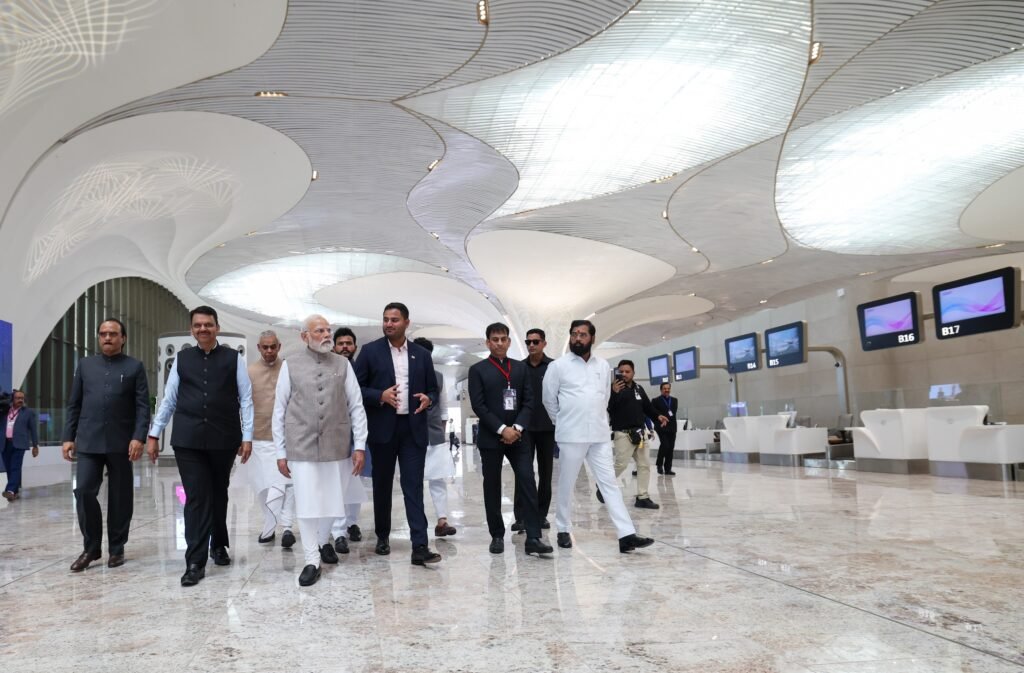
A Walkthrough of Innovation and Sustainability
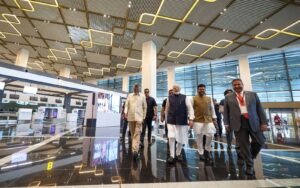
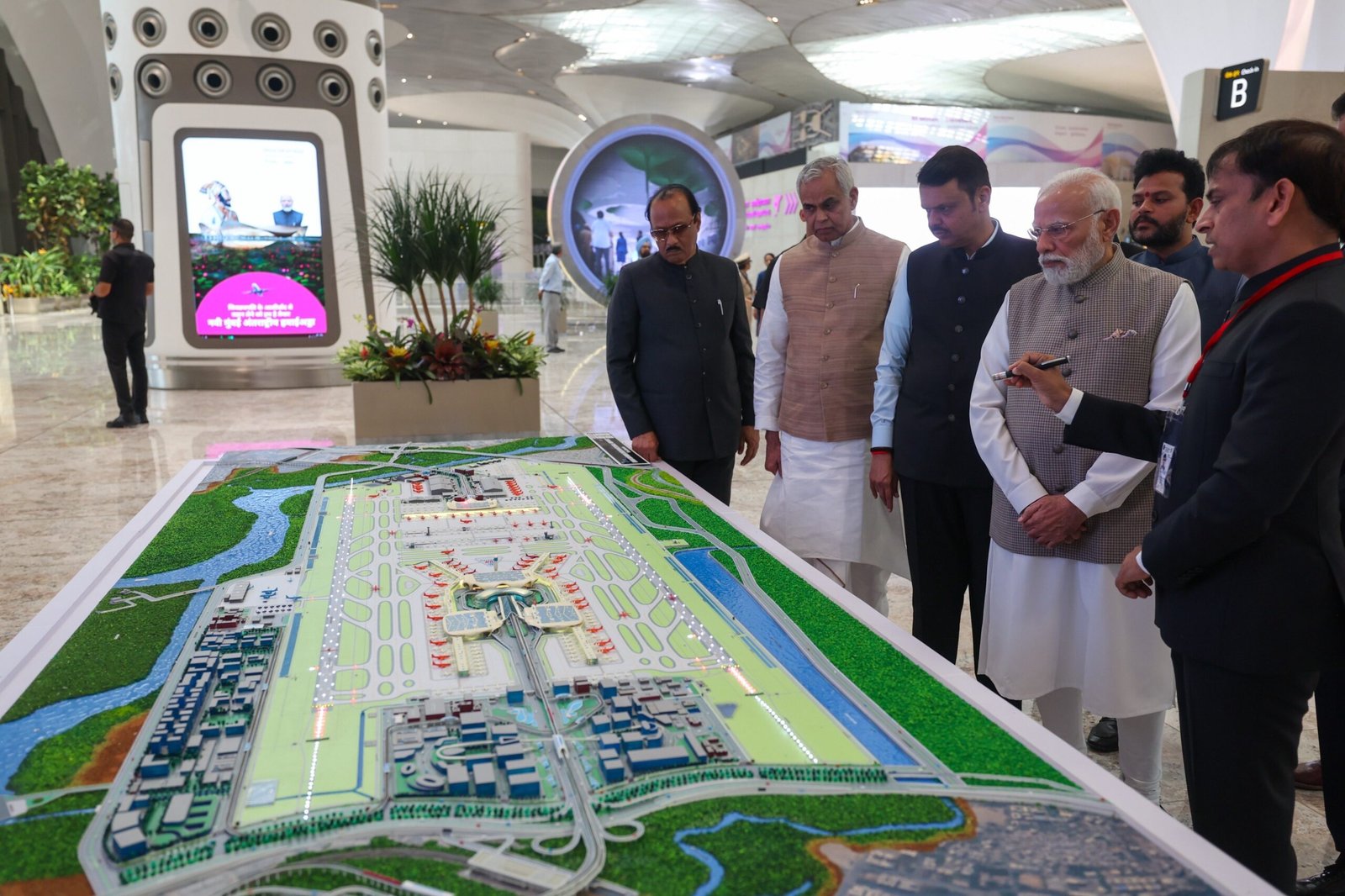
PM Modi’s afternoon visit began with a guided walkthrough of the facility at around 3 PM, where he inspected the sleek interiors and cutting-edge amenities. Designed by the renowned Zaha Hadid Architects, Terminal 1 boasts a futuristic aesthetic with fluid lines and expansive glass facades that flood the space with natural light. The terminal, spanning 3.5 lakh square meters, is equipped with advanced biometric check-in systems, automated baggage handling, and ample lounges for both domestic and international travelers.
What sets NMIA apart is its unwavering commitment to sustainability. As India’s first net-zero carbon emissions airport, it features solar panels generating 30 MW of power, rainwater harvesting systems, and electric vehicle charging stations across its 1,160-hectare campus. A temporary air traffic control (ATC) tower, operational for the initial 6-7 years, overlooks a 3.7 km runway capable of handling wide-body aircraft like the Boeing 747. Phase 1 alone will support 20-22 hourly flights and accommodate 20 million passengers annually, with full capacity projected within 12-15 months.
“The inauguration of NMIA and other connectivity projects will strengthen Mumbai’s position as a global hub of growth and opportunity,” PM Modi remarked during his address, emphasizing how the airport aligns with the vision of ‘Viksit Bharat’ (Developed India). He also launched the Mumbai One app, a unified digital platform integrating airport services, metro ticketing, and urban mobility solutions, further streamlining commuter experiences.
Easing Mumbai’s Air Traffic Woes
Mumbai’s skies have long been strained, with CSMIA handling over 50 million passengers pre-pandemic and facing delays due to limited slots. NMIA’s strategic location—connected via the upcoming Navi Mumbai Metro, the Atal Setu sea bridge, and proposed road corridors—promises to redistribute traffic efficiently. In the short term, it will absorb general aviation, business jets, and charter flights from CSMIA, freeing up slots for commercial operations.
Commercial flights are slated to commence in December 2025, with initial services from Air India, IndiGo, and Akasa Air. Domestic routes to Delhi, Bengaluru, and Hyderabad will kick off, followed by international connections to Southeast Asia and the Middle East. Long-term plans envision NMIA as a pivotal East-West transfer hub, enabling seamless connections from Southeast Asia to Europe and North America. By 2030, the airport aims to handle 90 million passengers and 800,000 tonnes of cargo annually across four terminals and parallel runways.
Gautam Adani, Chairman of the Adani Group, hailed the workforce behind the project during a pre-inauguration visit, thanking “differently-abled colleagues, construction workers, women staff, engineers, artisans, firefighters, and guards” for their role in this monumental achievement.
Broader Implications for India’s Aviation Boom
The launch comes amid a flurry of aviation milestones this month, including the upcoming inauguration of Noida International Airport on October 30. With India’s passenger traffic projected to surpass 300 million by 2030, NMIA underscores the government’s push for world-class infrastructure. It not only boosts regional logistics—catering to the booming industrial belts of Navi Mumbai and Pune—but also generates thousands of jobs in hospitality, retail, and ancillary services.
Experts predict NMIA will catalyze economic growth in the MMR, enhancing connectivity for the IT hubs of Thane and Navi Mumbai while positioning India as a competitive player in global aviation. As Captain B V J K Sharma, CEO of NMIA, noted, “This is more than an airport; it’s a gateway to opportunities that will connect dreams across borders.”
As the first flights prepare for takeoff, NMIA stands as a testament to India’s resilient spirit and ambitious future—one where the skies are no longer a limit, but a launchpad for progress. Travelers and stakeholders alike eagerly await the December debut, ready to soar into a connected tomorrow.






+ There are no comments
Add yours