






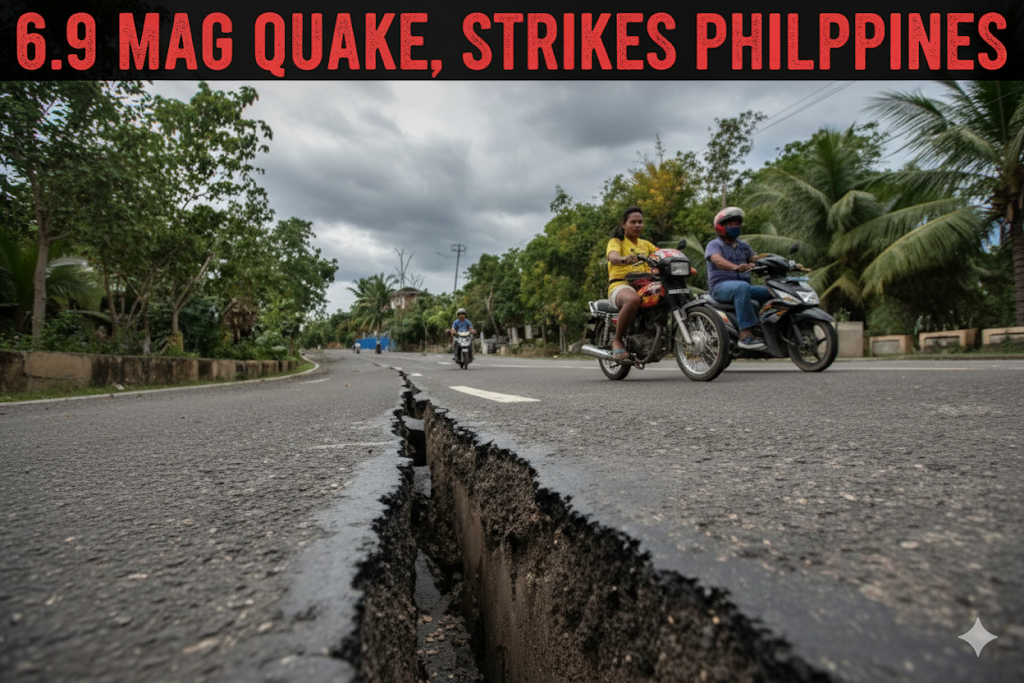
October 1, 2025 – A powerful 6.9-magnitude earthquake rocked the central Philippines late Tuesday, claiming at least 69 lives and injuring over 147 others in a region already reeling from recent typhoons. The quake, centered offshore near Bogo City in Cebu province, triggered widespread panic, collapsed buildings, and overwhelmed hospitals, prompting authorities to declare a “state of calamity” as search-and-rescue operations continue into the night.
The United States Geological Survey (USGS) reported the tremor striking at approximately 8:10 p.m. local time (12:10 p.m. UTC), with an epicenter in the Visayan Sea about 11.10°N, 124.10°E, at a shallow depth of just 5 kilometers. While some local reports pegged the magnitude at 6.7, the shallow focus amplified its destructive force, shaking Cebu and neighboring islands like Leyte and Samar. No tsunami warning was issued, but the Philippine Institute of Volcanology and Seismology (PHIVOLCS) warned of potential aftershocks, urging residents to brace for more tremors.
In Cebu, the hardest-hit province, the death toll stood at 69 by early Wednesday, with 147 injuries reported, according to the Office of Civil Defense (OCD). Hospitals in Cebu City and Mandaue were swamped, treating victims for crush injuries, fractures, and trauma. “We are stretched thin—many are still under rubble, and our teams are working around the clock,” said OCD spokesperson Edgar Posadas. In Bogo City, rescuers combed through debris of a collapsed multi-story building, where three people remained missing, their cries faintly audible amid the chaos.
Eyewitness accounts painted a harrowing picture. “The ground shook like it was alive—buildings swayed, and then the screams,” recounted Maria Santos, a teacher from Mandaue whose school partially caved in, trapping students briefly. Power outages plunged swaths of Cebu into darkness, complicating relief efforts, while roads buckled and bridges sustained damage, hampering access to remote barangays. The quake’s timing—during evening rush hour—exacerbated the toll, catching commuters and families off-guard.
President Ferdinand Marcos Jr. swiftly mobilized the National Disaster Risk Reduction and Management Council (NDRRMC), declaring Cebu under a state of calamity to unlock emergency funds and expedite aid. “Our thoughts are with the families of the lost and injured. We will spare no resource in recovery,” Marcos posted on X, formerly Twitter. International aid offers poured in, with the U.S. Embassy in Manila pledging logistical support, and the Red Cross deploying teams from across Asia.
This disaster compounds the Philippines’ woes in a year battered by climate extremes. Just weeks ago, Typhoon Yagi left 100 dead and displaced millions; now, this seismic event underscores the archipelago’s vulnerability in the Pacific Ring of Fire, where 20 typhoons and frequent quakes are annual norms. Experts at PHIVOLCS attribute the tremor to the Philippine Trench, a subduction zone where the Philippine Sea Plate dives beneath the Eurasian Plate, fueling such high-intensity events.
As dawn breaks, volunteers and military personnel fan out across Cebu, distributing water, tents, and medical supplies. Schools and offices remain shuttered, with classes suspended province-wide. While the immediate threat has passed, the emotional and economic scars will linger—damages are estimated in the billions of pesos, with agriculture and tourism sectors hardest hit.
The resilience of Filipinos shines through, as communities rally with prayers and mutual aid. “We’ve faced worse, but together, we rebuild,” said local priest Father Reyes during a midnight vigil in Bogo. Global prayers echo for the afflicted, as rescuers race against time to save those trapped. Updates from the ground will follow as the situation evolves.














+ There are no comments
Add yours